
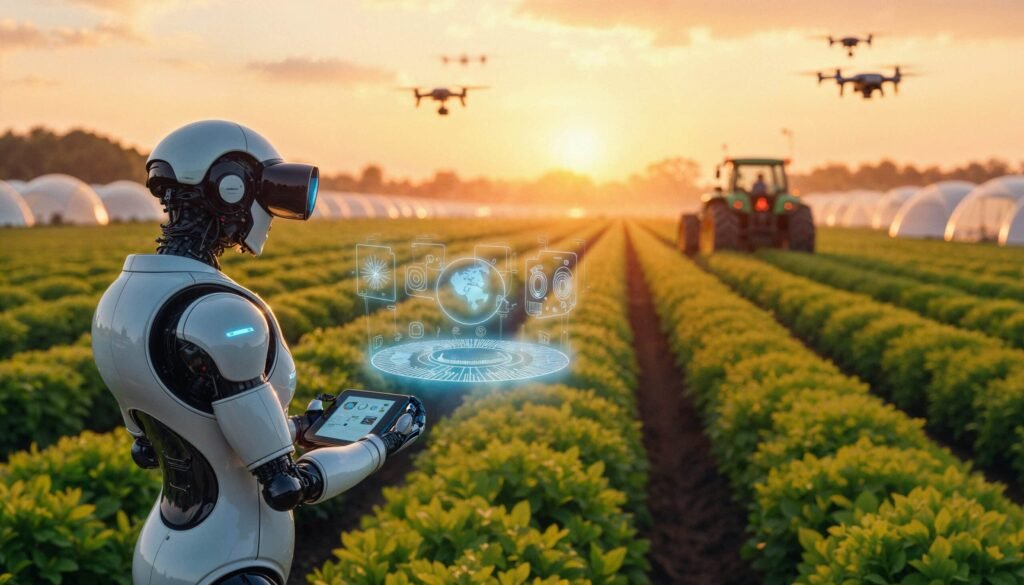
Artificial intelligence is moving beyond offices and technology companies and into the fields, farms and livestock operations of Pakistan. From crop monitoring and smart irrigation to pest detection, weather forecasting and farm analytics, AI is giving farmers new ways to make faster and more informed decisions.
Pakistan’s agriculture sector remains a major part of the economy, while water availability, climate variability, rising input costs and productivity remain important challenges. The Pakistan Economic Survey 2025-26 reported agriculture growth of 2.89% during the year, highlighting the importance of improving productivity and resource efficiency.
What Is AI Farming?
AI farming, also known as smart agriculture or precision agriculture, uses artificial intelligence, sensors, satellite imagery, drones and data analytics to help farmers understand what is happening in their fields.
Instead of treating an entire farm in exactly the same way, technology can help identify differences in soil moisture, crop health, nutrient requirements and pest pressure.
The result is a more data-driven approach to farming.
AI Can Improve Crop Monitoring
One of the most useful applications of AI is real-time crop monitoring.
Drones and cameras can capture images of farmland, while AI-based systems can analyze those images to identify unusual crop patterns. Farmers may detect areas affected by:
- Water stress
- Nutrient deficiencies
- Pest attacks
- Disease
- Poor plant growth
- Weed infestation
Punjab’s Agriculture Department is already promoting drone technology for crop-health and crop-nutrition monitoring, noting its potential to identify problems early and optimize agricultural inputs.
Smart Irrigation Can Save Water
Water management is becoming increasingly important for Pakistani agriculture.
AI-powered irrigation systems can combine soil-moisture data, weather information and crop requirements to help determine when and where irrigation is needed.
Instead of irrigating an entire field on a fixed schedule, precision agriculture can help farmers target water where it is most needed.
This approach is particularly relevant as Pakistan manages limited irrigation resources. The Economic Survey reported total surface-water availability of 92.0 million acre-feet during 2025-26, below the long-term average system usage of 103.5 million acre-feet.
AI Helps Detect Crop Diseases and Pests
Early detection can make a major difference in crop management.
AI-powered image recognition can analyze photographs of leaves and plants to identify signs associated with diseases or pest attacks. Farmers can then investigate affected areas and take appropriate action rather than automatically treating an entire field.
This can potentially reduce unnecessary pesticide use and improve integrated pest management.
Drones and AI Are Changing Precision Farming
Agricultural drones can collect detailed information from fields much faster than traditional inspection methods.
AI can analyze drone imagery to create useful field maps showing variations in crop growth, vegetation health and potential problem areas.
Punjab’s ongoing agricultural research program specifically identifies AI, IoT, drones, genomics and speed breeding as technologies being integrated into modern agricultural research and climate-smart farming.
AI in Livestock and Dairy Farming
The technology is not limited to crops.
AI can also support livestock management by analyzing information about animal activity, feeding, milk production and health.
For dairy farmers, digital monitoring systems could help identify changes in an animal’s behavior or productivity that may require closer observation.
This can help farmers move toward more data-based dairy herd management.
AI Can Help Farmers Make Better Decisions
One of AI’s biggest advantages is its ability to process large amounts of information.
A smart farming platform could combine:
Weather + soil data + crop stage + satellite imagery + irrigation information + historical farm records
to provide recommendations for farm management.
This could help farmers decide when to irrigate, monitor crops, inspect specific field zones or plan agricultural operations.
What Is the Future of AI Farming in Pakistan?
AI will not replace the farmer. Instead, its biggest value may come from helping farmers make better decisions with better information.
However, adoption will depend on affordable technology, reliable internet connectivity, farmer education, local-language tools, technical support and trustworthy agricultural data.
Pakistan is already moving toward greater use of advanced agricultural technologies. Punjab’s current research modernization program includes AI, IoT and drone-based precision agriculture as part of efforts to improve productivity, resilience and resource efficiency.
Final Thoughts
Artificial intelligence in agriculture could become one of the most important developments in Pakistan’s farming sector. From smart irrigation and crop surveillance to disease detection, drones, livestock monitoring and predictive farm analytics, AI can help farmers use resources more efficiently.
The future Pakistani farm may combine traditional agricultural knowledge with AI, satellite technology, sensors and precision farming—creating a smarter, more productive and climate-resilient agricultural system.
For more practical information about modern farming, crop production, livestock, agricultural technology and smart agriculture in Pakistan, follow PakFarming.com.