
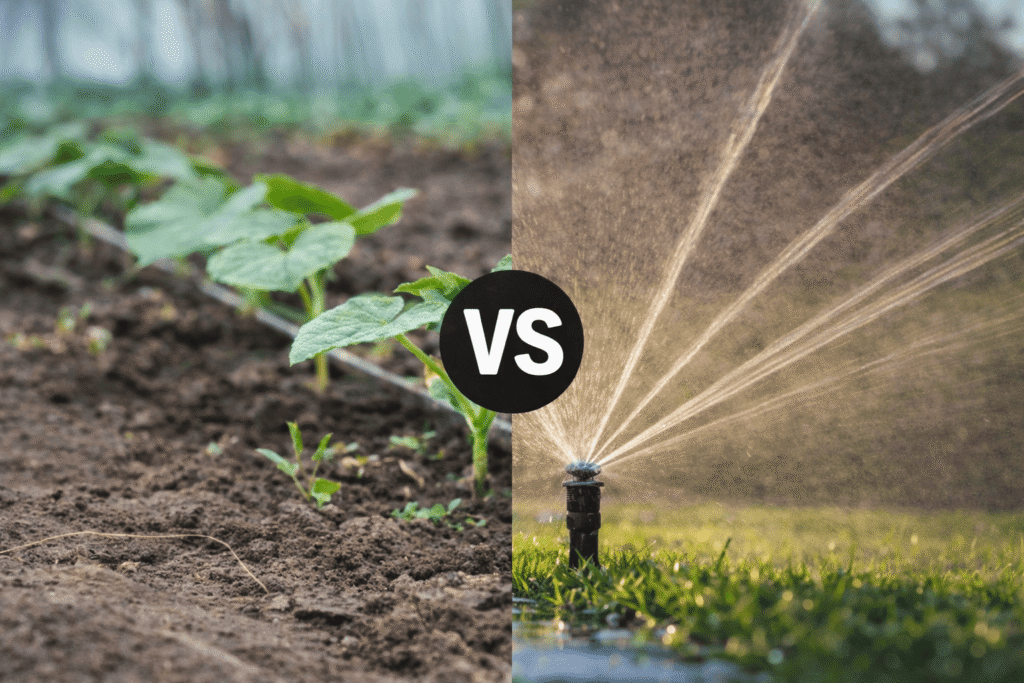
Water is one of the most valuable resources on any farm. The way farmers deliver that water can influence crop yield, water consumption, energy use, labor requirements, soil health, and profitability.
Two widely used approaches are drip irrigation and flood irrigation. Flood irrigation relies on gravity to move water across the field, while drip irrigation delivers controlled amounts of water close to the plant’s root zone.
So, which irrigation method is better? The answer depends on the crop, soil, field conditions, water availability, farm size, climate, and budget.
What Is Drip Irrigation?
Drip irrigation is a precision irrigation system that delivers water slowly through emitters installed along pipes, drip lines, or tubing.
Instead of wetting the entire field, the system directs water toward the areas where crops need it most.
Modern drip systems can also support fertigation, allowing farmers to deliver soluble nutrients through irrigation water.
Advantages of Drip Irrigation
- Delivers water close to plant roots
- Reduces unnecessary evaporation
- Can reduce runoff and deep percolation
- Supports precise irrigation scheduling
- Works well for vegetables, orchards, vineyards, and specialty crops
- Can reduce weed growth between crop rows
- Allows efficient fertilizer application
- Can reduce labor and energy requirements when properly designed
USDA and university extension resources generally identify drip and other pressurized systems as more water-use efficient than many gravity systems because they can reduce losses from runoff, evaporation, and deep percolation.
What Is Flood Irrigation?
Flood irrigation is a traditional gravity-based irrigation method. Farmers release water onto a field, basin, or furrow and allow gravity to distribute it across the soil.
It remains important for many agricultural systems because it can be relatively simple and inexpensive to install.
Flood irrigation can work particularly well when farmers have suitable land leveling, adequate water supply, appropriate soil conditions, and crops that tolerate or require broader wetting.
Rice is one notable example where flooding plays an important role in production. USDA research also shows that irrigation practices vary significantly according to crop, soil, production system, and regional conditions.
Drip Irrigation vs Flood Irrigation: Key Differences
| Factor | Drip Irrigation | Flood Irrigation |
|---|---|---|
| Water delivery | Directly near plants | Across field surface |
| Water precision | Very high | Lower |
| Initial investment | Higher | Usually lower |
| Labor | Lower after installation | Can be higher |
| Water efficiency | Generally higher | Generally lower |
| Fertilizer application | Easy through fertigation | Less precise |
| Field requirements | Flexible | Benefits from suitable grading |
| Best suited for | Orchards, vegetables, high-value crops | Rice, field crops and suitable flat fields |
| Maintenance | Emitters and lines require attention | Simpler infrastructure |
| Automation | Highly suitable | Possible but more limited |
Which Uses Less Water?
In many field conditions, drip irrigation uses less water than conventional flood irrigation because it places water closer to the crop root zone.
USDA Agricultural Research Service research has found substantial water-use advantages for drip irrigation in certain crops and growing conditions. In one blueberry study, drip irrigation produced strong plant growth using considerably less irrigation water than sprinkler and microspray systems.
However, irrigation efficiency is not determined by the technology alone.
A poorly managed drip system can waste water, while a carefully designed flood system can perform much better than a poorly managed conventional system.
USDA research notes that irrigation application efficiency varies widely among flood, sprinkler, and drip systems and depends heavily on management and site conditions.
Which Is More Affordable?
This is where flood irrigation often has an advantage.
A basic flood irrigation system can require relatively simple infrastructure. Drip irrigation needs tubing, filters, emitters, pressure management, valves, and sometimes pumps and automation.
That means drip irrigation usually has a higher upfront cost.
However, farmers should look beyond installation expenses. Reduced water use, lower pumping requirements, better nutrient management, and potentially improved crop productivity can influence the long-term economics.
USDA’s Farm Service Agency notes that improving irrigation efficiency can help reduce water, energy, chemical, and labor expenditures while potentially improving crop returns.
Which Irrigation Method Is Better for Crop Yield?
There is no universal winner.
Drip irrigation can provide more consistent moisture around the root zone and can be particularly useful for crops requiring precise water management. USDA research has found that drip systems can improve crop water productivity under appropriate management.
Flood irrigation, meanwhile, can remain practical for crops and fields where broad water distribution is suitable.
The best irrigation method is the one that delivers the right amount of water at the right time without creating unnecessary losses.
Drip Irrigation Is Not Maintenance-Free
One common misconception is that installing drip lines solves every irrigation problem.
Drip systems require proper filtration, pressure control, flushing, inspection, and maintenance. Emitters can become clogged because of sediment, minerals, algae, or other material in irrigation water.
Farmers should regularly check:
- Water pressure
- Filters
- Emitters
- Pipe connections
- Leaks
- Clogging
- Soil moisture
- Irrigation schedules
Good maintenance can extend system life and protect the investment.
When Does Flood Irrigation Make Sense?
Flood irrigation can still be a sensible choice when:
- Water is readily available
- The field has suitable topography
- Land can be properly leveled
- The crop suits surface irrigation
- Installation budgets are limited
- A simple irrigation system is preferred
- Water losses can be controlled through good management
Improved land leveling, field design, irrigation scheduling, and water management can make gravity irrigation substantially more effective.
USDA data also shows that irrigation systems differ considerably by crop and region, demonstrating that farmers should select technology according to actual field requirements rather than following a one-size-fits-all approach.
Which One Should Farmers Choose?
For many water-conscious and high-value farming operations, drip irrigation offers major advantages in precision and water management.
For suitable large fields and crops, flood irrigation can remain an economical and practical option, especially where water and field conditions make gravity distribution effective.
Before switching systems, farmers should compare:
- Current water consumption
- Pumping and electricity costs
- Crop value
- Expected water savings
- Installation expenses
- Maintenance requirements
- Soil type
- Field slope and size
- Water quality
- Available labor
Final Verdict
Drip irrigation is generally the better choice when water efficiency, precision, fertigation, and controlled crop production are priorities. Flood irrigation can be more economical and practical where field conditions, crop requirements, and water availability support gravity irrigation.
The real goal is not simply choosing the newest technology. It is choosing an irrigation system that makes every drop count while protecting farm profitability, soil quality, and long-term water resources.
As agriculture becomes increasingly focused on water conservation and climate resilience, farmers can combine better irrigation scheduling, soil-moisture monitoring, efficient equipment, and appropriate irrigation technology to produce more with fewer resources.