
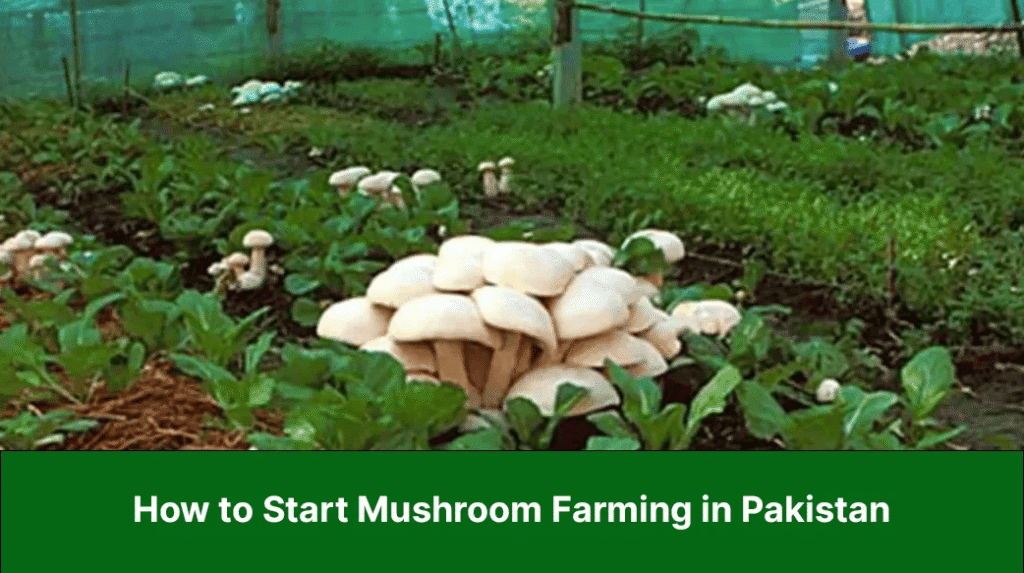
Mushroom farming in Pakistan is an emerging agricultural business that can turn a small indoor space into a productive farm. Unlike conventional crops, mushrooms do not require large fields, and farmers can grow them in controlled rooms using agricultural by-products such as wheat straw, rice straw, sawdust, and other suitable materials.
For beginners, oyster mushroom farming is an attractive starting point because the crop can be cultivated on several types of agricultural waste and follows a relatively straightforward production process. Pakistani research has also evaluated wheat straw, sawdust, cardboard, and other locally available substrates for oyster mushroom production.
If you are searching for how to start mushroom farming, this guide explains the basic process, equipment, costs, marketing opportunities, and mistakes to avoid.
Why Start a Mushroom Farming Business?
Mushrooms offer several advantages compared with conventional field crops.
You can potentially:
- Start production on limited land
- Grow mushrooms indoors
- Use agricultural waste as a growing medium
- Produce multiple harvests from a growing cycle
- Supply restaurants and grocery businesses
- Sell fresh or processed mushrooms
- Scale production gradually
A major advantage is that mushroom cultivation can convert agricultural residues into a food product, creating additional value from materials that might otherwise have limited economic value.
Choose the Right Mushroom Variety
The first major decision is selecting a mushroom species.
Oyster Mushrooms
Oyster mushrooms (Pleurotus spp.) are generally a practical choice for beginners. They can grow on materials such as wheat straw, rice straw, sawdust, cotton waste, and other suitable agricultural residues.
Button Mushrooms
Button mushrooms have strong commercial demand but require more specialized environmental management and composting.
Shiitake Mushrooms
Shiitake can target premium markets, although production methods and growing requirements differ from oyster mushrooms.
For a new farmer, starting with oyster mushroom cultivation can make the learning process easier before moving into more specialized varieties.
Step 1: Select a Suitable Growing Space
You do not necessarily need expensive farmland.
A clean room, shed, or purpose-built growing facility can be adapted for mushroom production. The space should allow you to manage:
- Temperature
- Humidity
- Ventilation
- Cleanliness
- Lighting
- Water supply
- Pest and contamination control
Your growing room should also be easy to clean and preferably separated from areas where dirty substrate, waste, or animals are kept.
Step 2: Prepare the Mushroom Substrate
The substrate is the material on which mushroom mycelium grows.
For oyster mushrooms, common options include:
- Wheat straw
- Rice straw
- Sawdust
- Cotton waste
- Sugarcane-related agricultural residues
- Other suitable plant materials
Wheat straw is particularly relevant for Pakistan because it is widely available in agricultural areas.
The substrate is normally chopped, hydrated, and treated to reduce competing microorganisms before mushroom spawn is introduced. ICAR-IIHR describes chopped straw, moisture management, and hot-water or steam pasteurization as established oyster mushroom cultivation practices.
Step 3: Pasteurize the Substrate
This is one of the most important stages.
Untreated agricultural waste can contain molds, bacteria, insects, and other organisms that compete with mushroom mycelium.
For small-scale oyster mushroom production, hot-water pasteurization can be practical. Larger operations may use steam-based systems or commercial sterilization equipment.
After treatment, allow the substrate to cool before spawning.
Never add mushroom spawn to excessively hot substrate, because high temperatures can damage the living mycelium.
Step 4: Add Mushroom Spawn
Mushroom spawn acts somewhat like seed in conventional crop production. It contains actively growing mushroom mycelium.
Mix or layer the spawn with the prepared substrate and pack the material into clean polypropylene or suitable cultivation bags.
Good hygiene is critical during this stage.
Use clean tools, clean surfaces, quality spawn, and properly treated substrate to reduce contamination.
Step 5: Incubate the Bags
Place the inoculated bags in a clean incubation area.
During spawn running, the white mycelium gradually spreads through the substrate.
The exact temperature and duration depend on the mushroom variety and production system. For oyster mushrooms, published cultivation guides commonly use controlled conditions around the low-to-mid 20s °C during colonization.
Avoid unnecessary disturbance during this stage.
The objective is to allow the mycelium to colonize the substrate uniformly.
Step 6: Move to the Fruiting Room
Once the substrate is adequately colonized, prepare the bags for fruiting.
Small openings or slits can be made in suitable positions so mushroom clusters can emerge.
At this stage, humidity, fresh air, temperature, and appropriate light become important.
Pakistan-focused research on oyster mushrooms found favorable results under controlled temperature and humidity conditions, although the optimum can vary by substrate and variety.
Do not rely on a single temperature number for every mushroom species. Always follow requirements for the specific variety you grow.
Step 7: Control Humidity and Ventilation
Mushrooms require adequate moisture, but excessive wetness can create contamination problems.
Use a hygrometer to monitor relative humidity and maintain suitable environmental conditions.
Fresh-air exchange is equally important. Poor ventilation can lead to excessive carbon dioxide and abnormal mushroom development.
A good growing room therefore needs a balance between:
Humidity + Fresh Air + Temperature + Cleanliness
Avoid directly soaking developing mushrooms. Fine misting and appropriate environmental control are generally preferable to flooding the growing area with water.
Step 8: Harvest the Mushrooms
Harvest timing affects quality and market value.
Oyster mushrooms are generally harvested when the caps have developed properly but before they become excessively mature.
Gently twist or cut the clusters while avoiding unnecessary damage to the growing substrate.
Commercial production can produce multiple flushes, meaning additional rounds of mushrooms from the same growing block under suitable conditions.
Basic Equipment for a Small Mushroom Farm
A beginner may need:
- Growing bags
- Mushroom spawn
- Agricultural substrate
- Shelving or racks
- Large containers for pasteurization
- Water sprayer or misting system
- Hygrometer
- Thermometer
- Fans or ventilation equipment
- Cleaning supplies
- Harvesting containers
- Packaging materials
As production expands, farmers can add humidifiers, environmental controllers, cooling equipment, better shelving, and dedicated pasteurization facilities.
How Much Does Mushroom Farming Cost?
There is no universal startup cost because the investment depends on production capacity and whether you already have a suitable building.
Your budget should include:
Facility + racks + spawn + substrate + bags + pasteurization + water + electricity + labor + packaging + transportation + marketing.
Start with a small pilot batch instead of investing heavily at the beginning.
This lets you learn contamination control, environmental management, harvesting, and customer preferences before expanding.
How to Sell Mushrooms in Pakistan
Growing mushrooms is only half the business. Finding customers is equally important.
Potential buyers include:
- Restaurants
- Hotels
- Supermarkets
- Grocery stores
- Vegetable shops
- Caterers
- Health-conscious consumers
- Online grocery businesses
- Food processors
Fresh mushrooms are perishable, so develop your sales network before production reaches commercial scale.
You can also explore dried mushrooms, mushroom powder, packaged products, and value-added foods where regulations, food safety requirements, and market demand support them.
Common Mushroom Farming Mistakes
New growers often focus on production while overlooking basic farm hygiene.
Avoid:
- Using poor-quality spawn
- Skipping substrate treatment
- Overwatering
- Poor ventilation
- Dirty growing rooms
- Overcrowding bags
- Ignoring temperature changes
- Expanding before mastering a small batch
- Producing without identifying buyers
Contamination is one of the biggest risks in mushroom cultivation. A clean production workflow can protect both yield and profitability.
Is Mushroom Farming Profitable?
Mushroom farming can be profitable, but profitability is never guaranteed.
Your financial results depend on:
Selling price − production costs = operating profit
Production costs include spawn, substrate, labor, electricity, water, packaging, transportation, equipment depreciation, contamination losses, and unsold inventory.
The strongest business model is not simply producing the maximum quantity. It is producing consistent quality at a controlled cost and selling efficiently.
Final Thoughts
Starting a mushroom farming business in Pakistan can be an interesting opportunity for farmers, agricultural entrepreneurs, and small businesses looking for a high-value indoor farming model.
For beginners, oyster mushrooms provide a practical entry point because they can use locally available agricultural residues and do not require traditional farmland.
Start small, learn the cultivation cycle, maintain strict hygiene, monitor temperature and humidity, build reliable buyers, and calculate every production expense.
With proper planning, mushroom cultivation can become more than a small farming experiment—it can develop into a scalable agribusiness built around efficient use of space, agricultural waste, and growing consumer demand.
For more practical guides on modern farming, agricultural business ideas, crop production, irrigation, livestock, and agribusiness in Pakistan, visit PakFarming.com.
MALIK HOMOEO HERITAGE CLINIC
https://wwwv.malikhomeoheritage.com.
Established 1925.
03291087951
INTEGRATION & INNOVATION IN HOMOEOPATHY
Health Care Solutions & Vision 2050
Author:
Dr. Aamir Nazeer Malik
CEO & Founder
Malik Homoeo Heritage Clinic
*WORLD’S BIGGEST FATAL DISASTERS:*
Air Pollution
Carcinogens & Mutagens
Cancer
Pandemics
Radiation Threats
Autism.
Abstract
This academic framework presents an integrative and innovative vision for homoeopathy aligned with Health Care Vision 2050. It emphasizes research-driven advancement, scientific integration, and preparedness for future global health challenges while preserving the foundational principles of classical homoeopathy.
—
1. Research & Development (R&D) Foundation
Advanced research on Q-potencies, 10M, CM, and ultra-high dilutions, focusing on the molecular, nano-structural, and biophysical basis of homoeopathic medicines. This approach aims to bridge classical principles with modern scientific validation.
—
2. King & Queen Remedies in Homoeopathy
An integrative clinical model identifying primary (King) and supportive (Queen) remedies, enabling structured prescribing, therapeutic precision, and long-term constitutional harmony.
—
3. Red Box & Black Box Medicines in Homoeopathy
Red Box Medicines: Emergency, acute, and epidemic-response remedies.
Black Box Medicines: Chronic, constitutional, and deep-acting remedies for sustainable healing and disease modulation.
—
4. Bio-Molecular & Nano-Integrative Homoeopathy
Integration of homoeopathy with bio-molecular science, cellular signaling, epigenetics, and nano-medicine, positioning homoeopathy within future biomedical and integrative health models.
—
5. Pandemic Preparedness & Global Health Strategy
Homoeopathy as a preventive, immune-modulatory, and recovery-supportive system to address present and future pandemics in coordination with global public health strategies.
—
6. Mission of the Founder – Dr. Samuel Frederick Hahnemann
Continuation and modernization of Dr. Hahnemann’s mission of gentle, rapid, and permanent cure through scientific inquiry, academic collaboration, and integrative healthcare systems.
Integrative & Innovative Approach to Global Health Challenges – Vision 2050
7-)Our mission: to protect humanity from the next wave of global health threats.
1️⃣ Air Pollution & Cancer — 4.8 million deaths annually (WHO). How can we neutralize carcinogens and protect lung health?
2️⃣ Future Pandemics — What are our next-generation prevention and treatment strategies?
3️⃣ Radiation & War Hazards — How can we defend human DNA from radioactive isotopes (Uranium, Plutonium)?
4️⃣ Cancer Immunity — Can we correct immune errors and activate Natural Killer (NK) cells to destroy cancer naturally?
5️⃣ Autism Care — Let’s protect and empower autistic children through compassion, science, and inclusion.
💠 Our Vision:
To build a safer, healthier world for future generations — through integrative medicine, environmental protection, and advanced immune research.
💠 Our Commitment:
Innovate today to secure health in 2050.
🔬 Visit: http://www.malikhomeoheritage.com
🌿 Malik Homeo Heritage Clinic – Lahore (Est. 1925)
“Protecting Tomorrow’s Health, Today.”
—
Keywords
Homoeopathy, Innovation, Integration, Vision 2050, Nano-medicine, Bio-molecular Medicine, Pandemic Preparedness, R&D
For Academic & Institutional Circulation
Malik Homoeo Heritage Clinic – Health Care Solutions & Vision 2050